Friday, 25 September 2026

In My Seed Box For 2027 - Green Manure


My green manures are kept in a tin in the allotment shed and they are always sown insitu and currently I know I have a few packs left over from last year, but I don't have a clue what ones are left. Note to self do Green Manure audit when next on the plot.

Green manures can also be used to cover bare patches of soil in the spaces between crops, or during intervals between one crop and the next. Fast-growing mustard sown before mid-September can be incorporated in October, for example, or the frosted remains left as mulch.

Summer-grown green manures such as buckwheat and fenugreek form dense foliage that will effectively suppress weeds.

Green manures belonging to the pea and bean family (legumes) have the additional capacity of storing (fixing) nitrogen from the air to their root nodules, but only in summer. Nitrogen is a valuable plant nutrient.

Other benefits of green manures include protection of the soil surface from compaction by rain and shelter for beneficial insects such as ground beetles.

How To Use Green Manures

  • Sow seeds in rows, or broadcast them across the soil and rake into the surface
  • Once the land is needed for cropping, chop the foliage down and leave it to wilt
  • Dig the plants and foliage into the top 25cm (10in) of soil After digging in, the site should be left for two weeks or more before sowing or planting out as decaying green materials can hamper plant growth

Cultivar Selection

Alfalfa (Medicago sativa): This perennial legume can be dug in after two or three months or left for one to two years; sow in April to July; good for alkaline soils. Nitrogen fixing may only occur if the seed is inoculated with nitrogen fixing bacteria prior to sowing.

Alsike clover (Trifolium hybridum): This perennial legume can either be dug in after two or three months or left in for one or two years; good for wet, acid soils; sow in April to August.

Bitter blue lupin (Lupinus angustifolius): This perennial flowering legume suits light, sandy, acid soils; sow in March to June and leave for two or three months before digging in.

Buckwheat (Fagopyrum esculentum): This half hardy annual will only grow in spring and summer best sown in April to August, it can be left for two or three months after sowing; grows well on nutrient-poor soils.

Crimson clover (Trifolium incarnatum): This perennial legume is good for light soils; sow in March to August and leave in for two or three months up to flowering.

Essex red clover (Trifolium pratense): This hardy perennial legume overwinters well and can be left in for two or three months or for one or two years after sowing; good for loamy soils; sow March to August.

Fenugreek (Trigonella foenum-graecum): This annual legume will only grow in the spring and summer; it is unlikely to fix nitrogen in the UK.

Grazing rye (Secale cereale): This annual crop is good for soil structure and overwinters well; sow in August to November and dig in the following spring.

Mustard (Sinapis alba): This annual crop from the brassica family should not be followed by other brassicas, as it could encourage build-up of the disease clubroot; sow in March to September and leave for two or three months before digging in.

Phacelia (Phacelia tanacetifolia): Later sowings of this annual crop may overwinter in mild areas, but it is generally best sown in April to August and dug in after two or three months; its flowers are very pretty.

Trefoil (Medicago lupulina): This legume can be annual or biennial and overwinters well but needs light, dry alkaline soil; it can be dug in after two or three months or left for one or two years after sowing; sow in March to August.

Winter field bean (Vicia faba): This annual legume can be left for two or three months after sowing (up to flowering) and is good for heavy soils; sow in September to November.

Winter tares (Vicia sativa): This annual legume is hardy and overwinters well, even in heavy soils; sow either in March to August and leave for two or three months before digging in, or sow in July to September for overwintering.

Problems

A dense carpet of green makes a perfect environment for slugs and snails so control measures may be needed after green manuring.

Decaying green manures can suppress plant growth, so allow at least two weeks between incorporation and planting or sowing.

Club Root can be a problem with green manures in the cabbage family such as mustard.


Green Manure for use in 2026 

Green Manure - Red & White Clover 

Seedstosuit Seed Quantity 2g pack (cover for 1 square metre)  29p each 

With seedstosuit you only need to buy what you need, each pack is enough for 1 square metre.
 
My standard bed size is 2.4m x 1.2m = 2.88 sq.m 

If the contents cover 1 sq.m then I need 3 packs per bed. 

This wonderful mix of both red and white clover are not only beloved by bees, butterflies and tortoises (not that you find a lot of them on an allotment), they make a brilliant green manure. 

This blend of short and tall white clover can be cut back, and spreads with a creeping habit close to the surface which fixes nitrogen. You can expect it to last 2 - 5 years if required but doesn't like dry spells or areas. It is frost tolerant and an excellent weed suppressant. 

The red clover also fixes nitrogen and with its deep roots will be greatly beneficial to the soil once dug in. Perennial 
   
  
  • Sow outside March to August. Scatter thinly and light rake over in your prepared area.
  • Prefers moist conditions.
  • Full sun or partly shaded. 
  • days to germination: 14 - 24 days (white) 2 - 5 days (red).
  • Can be dug in 60 days after sowing or left until you choose. 

Thursday, 24 September 2026

In My Seed Box For 2027 - Celery


Celery was the one vegetable that I have tried to grow in the past but have never had a great deal of success with until I got some Tango Celery Postiplugs from Suttons in 2022. There were 18 Postiplugs when I used them in 2022 but they all went in at the same time, I just harvested from the tallest to the shortest. 

In 2023 I was planning to grow them from seeds but, the cancer and mobility issues meant that it didn't happen, so the plan at the moment is to grow them from seed in 2026

I will not try them in pots in the greenhouse as I have in the past but in the square foot gardening beds again on plot 1 as they have really been such a success in 2022.

New to Suttons for 2023 was the Tango F1 Hybrid Seeds in 2023 they were £3.49 for 40 seeds, and as of the date of this post they are still selling at £3.49  

The web site says sow in March and April, but I think these need to be sown in mid- February and brought on before planting out after the danger of frost has passed.  I'm planning on sowing 7 seeds in Mid-Feb, 7 seeds in Mid-March and another 6 in Mid-April so I can do some successive sowing and harvesting during 2027. The first 7 plants will go out under a cloche.

The harvest period is between August to the end of October or the first frost.   

The average life expectancy for Celery Seed is 8 to 12 years, and 40 seeds should hopefully last me for 2027 and 2028, as I aim to use 20 seeds a year.  This makes the cost of growing your own celery 8.7p per plant. 

Price of Celery, Sainsbury 80p - £1, Waitrose Green Celery Essential 95p Organic £1.25 Sainsbury Organic £1.25 and Tesco organic £1.25 and that's why we allotment holders and gardeners have a bash at growing a vast range of vegetables each year. 

It's a challenge, they taste better than shop bought, and they save us money, at least during the harvest period. 

In My Seed Box For 2027 - Index


Wednesday, 23 September 2026

In My Seed Box For 2027 - Celeriac

 Celeriac is something that I have not grown before but something I have wanted to try for a while. So, when I saw that Mr Fothergill’s had added Neon F1 to their catalogue for 2023, it was a bit of a no brainer.  Because of my battle with cancer and mobility issues between 2023 and 2026  I didn't manage to grow any, so hopefully the magic will happen in 2027. 

Celeriac – Mr Fothergill’s 

250 Seeds – £ 2.59 - Item code 38531 

Plants produce large roots for high yields. Known for its excellent garden performance and reliability. The white flesh roots are to use raw or cooked. An excellent source of vitamin C.

Sow Indoors a warm kitchen windowsill is all you need for starting these seeds, Sow 13mm (1/2") deep in trays of seed compost. Water well and place in a warm position. 

A temperature of 15-20C (60-68F) is ideal. Seedlings usually appear in 14-21 days.

Transplant to other trays 50mm (2") apart when seedlings are large enough to handle. Grow on in cooler, but not cold conditions. Gradually accustom young plants to outside conditions (avoid frost, before planting out 250mm (10") apart in rows of 300mm (1ft) apart. 

Plant so that the upper part of the root sits on the surface of the soil. Water well and remove outer leaves as roots swell. 

Below is what I found doing a google search on "Celeriac" 

What is celeriac?

Celeriac may look weird, but its flavour is familiar and its applications in the kitchen are practically endless. It's time to work this quirky root into your vegetable rotation. Here's what you need to know about celeriac (aka celery root).

Celeriac, or celery root, is one of the unsung heroes of the root vegetable world. It can be eaten raw or cooked, is a terrific substitution for potatoes in many applications and is wonderfully healthful! Whether you want to make a killer mash or a new refreshing salad, it's time to get to know this unique vegetable.

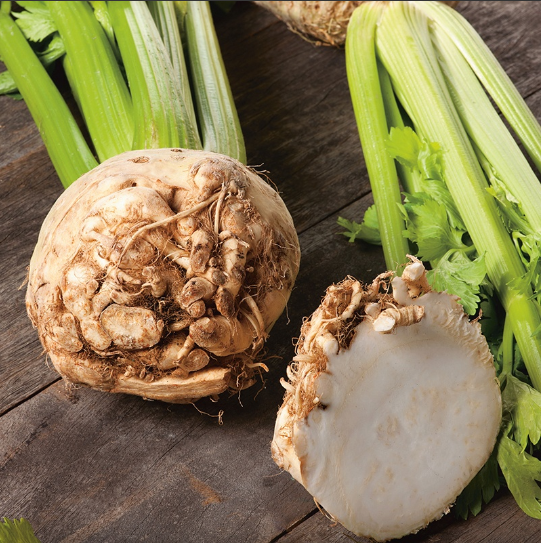
Celeriac is a root vegetable closely related to celery, parsley and parsnips. Its scientific name is Apium graveolens var. rapaceum, and it's also known as turnip-rooted celery, knob celery or celery root. It's a large, bumpy, brown vegetable that's harvested in the wintertime. It originated in the Mediterranean and belongs to the same plant family as carrots. It features in both classic recipes like celeriac rémoulade, a light salad that is similar to a coleslaw, and modern interpretations like gratins or purees, where it can be used as a lower-carb swap in for potatoes.

What does celeriac taste like?

Raw, celeriac has fantastic crunch and a super nutty, celery-like flavour that makes it perfect for salads and slaws. Cooked, it takes on a slight sweetness that works well mashed, baked, roasted or boiled.

Is celeriac healthier than potato?

With only 5.9 grams of carbs per 3.5 ounces (100 grams) of cooked vegetable, celeriac is a healthier, lower-carb alternative to potatoes. Plus, a crunchy, fresh, 3.5-ounce (100-gram) serving of raw celeriac has only 42 calories and 0.3 grams of fat — making it an excellent low-calorie food.

Is celeriac good for diabetics?

Contains only 15 grams of carbohydrates per cup, making it a great root vegetable for diabetics. 

What is celeriac good for?

Celeriac is a versatile, flavorful ingredient for soups, mashes, side dishes, and salads. It is a plentiful source of vitamins C and K, which can help support heart and bone health.

What does celeriac taste like?

Celeriac has a mild celery flavor with a refreshing crunch and a little bitterness when raw, and a subtle undertone of sweetness when cooked. If you like radish and turnips, you will love celeriac raw, and if you enjoy potatoes, you will like the cooked version.

How to select and store celeriac?

As with any root vegetable, you want to choose a firm root that feels heavy for its size and does not have soft or bruised patches. Celeriac has a thick outer skin that is often crusted with soil, and may have squiggly roots attached. Keep it in its original state in the crisper drawer of your fridge until you want to prep it for cooking. Kept cold and uncut, celeriac can last for a couple of weeks in your fridge.

What are the health benefits of celeriac?

Celeriac is packed with antioxidants (which can help fight inflammation), vitamins and minerals. When raw, it is an excellent source of vitamin K, as well as vitamin B6, vitamin C, phosphorous, magnesium and calcium. It is low in carbs and high in fiber, which can help support a healthy heart and gut . Also, it is naturally low in fat, making it a light, nutritious and refreshing add to your meal.

How to prep celeriac for cooking?

To prepare celeriac, slice both top and bottom off, then remove the thick skin. There is often a line that shows where the tough skin ends and the tender crisp flesh begins, so just follow that line. Once peeled, the celeriac can be grated, or cut into batons or cubes, or diced.

Uses for celeriac 

Celeriac is terrific in all sorts of dishes. In salads, raw, it provides excellent crunch and does not wilt quickly, so it is an ideal addition to slaws. Boiled or steamed, it can be pureed very smooth, providing creamy texture to soups or sauces. Roasted, it will brown and crisp on the edges, and get sweeter, making it ideal for any mixed roasted root vegetable dish. Because the texture can be similar to that of potato, it is great in gratins and mashes, but it does not exude starch the way a potato does, so often it is used with some potato to ensure that texture, anywhere from a 1-to-1 ratio to 1-to-4, depending on the dish. And it will retain excellent crunch when cooked hot and fast, so it can be a good addition to stir-fries and sautés. Finally, it makes for interesting pickles, either with other vegetables, as in a giardiniera, or just on its own.


References 

What Is Celeriac and How Do I Use It? | EatingWell

How to Cook and Serve Celeriac - Harvest to Table

This Is What Makes Celery And Celeriac Different From Each Other (mashed.com)

Tuesday, 22 September 2026

In My Seed Box for 2027 - Parsnips


I do love my Parsnips, they were however a bit of a failure in 2024 when the slugs and snails wiped out all 105 seedlings and I didn't get around to growing them in 2025 or 2026.
In 2026 I was hoping to repeating the success of 2016 & 2017 and have a full 2.4m x 1.2m beds worth that will be using the 105-hole planting membrane. That sadly didn't happen so now I'm hoping for a bed on Plot 1 and one in the Back Garden Allotment in 2027 

I have bought a pack of 250 seeds of Gladiator F1 from Seed Megastore for £1.59 for 2027 for Parsnips on plot 1 and my new Back Garden Allotment 
                                                   
In the past I have grown :-

Gladiator F1
Student  
Tender and True 


                                           Sow                            Harvest
Tender and True     Mid Feb - End May            Oct - Mid Feb 
Gladiator F1           Mid Feb - End May            Oct - Mid Feb 
Student                  Mid Feb - End May            Oct - Mid Feb 

Traditional sowing thinly in rows 400mm apart and cover with 13mm of fine soil firm gently and keep moist.

Germination seedlings appear 14 - 32 days 

Protect early sowings with cloches if soil is cold and wet

leave roots in the ground as flavour is improved by frost. leave remaining roots in February and store undamaged roots in sand in a dry frost-free area or process and freeze.    

I'm going to try chitting and growing in kitchen towel & loo rolls early as well as direct sowing in 2027. 

What Varieties do you grow and had the most success with?

When do you sow your Parsnips?

Do you chit the seeds or Sow Direct?


Monday, 21 September 2026

In My Seed Box For 2027 - Cauliflower


The life expectancy of cauliflower seed if kept in ideal conditions is 5 - 8 years. The saved to sow by date on most packs is only 2 years, I found one pack that was 4 years, Thus seeds should be viable but with a reducing germination rate each year for an additional 3 - 5 years beyond what it says on the pack. 

My History with Cauliflower is somewhat hit and miss, early on I had some really fantastic results but over the past years not so good. In 2022 I managed to get two really great looking cauliflowers after losing a lot of seedlings to the heatwave. 

In my seed box for 2027 are. 

Review of Seed Stock with Sow by date of 2020

White Step F1    - Thompson & Morgan  - 30 Seeds - £3.49 - Sow By 2020
Winter Aalsmeer - Thompson & Morgan - 50 Seeds - £2.49 - Sow By 2020

Review of Seed Stock with Sow by date of 2021

All Year Round   - Thompson & Morgan - 150 Seeds - £2.49 - Sow By 2021


Review of Seed Stock with Sow by date of 2022

Amsterdam F1    - Mr Fothergill's            -  25 Seeds - £ Mag - Sow by 2022
Sunset F1           - Marshalls                   -  15 Seeds - £2.29 - Sow by 2022


Review of Seed Stock with Sow by date of 2023

Orkney F1          - D.T.Brown                   -  30 Seeds - £2.59 - Sow by 2023
Zaragoza F1      - Dobies                          - 20 Seeds - £3.49 - Saved year ending 2021

Review of Seed Stock with Sow by date of 2025

De Purple F1     - Mr Fothergills               - 15 Seeds - £3.45 Sow by Dec 2025 
Cheesy F1         - Johnsons                     - 50 Seeds - £2.00^ Sow by Dec 2025
Ameresco F1     - Suttons                        - 12 Seeds - £4.49 Sow By 2025

^ Bought in wilko 50% Seed Sale for £1

Review of Seed Stock with Sow by date of 2027

Fioretto               - Dobies                          - 10 Seeds - £3.99 - Saved year ending 2024


Sowing Times vary for each variety

                                Indoors      Outside     Plant Out     Harvest 
All Year Round    - Feb - May   Mar-Jun                        Jun - Sep 
Amsterdam F1    - Mar - May     June          June          Oct - Jan
De purple F1       - Feb - Mar   Mar-Jun                        Jun - Oct
Fioretto                -                   Mar - Jun                       
Aug - Nov
Orkney F1           - Jan - Feb                       5 leaves     May - July
Orkney F1           - Sep - Oct                       5 leaves     May - July
Sunset F1           - Feb - Apr    Apr - May                       Aug - Oct 
White Step F1     -                    May - June                    Aug - Nov
Winter Aalsmeer -                    My - Mid Jun                  April

Sowing Plan

Jan - Orkney F1
Feb -  All Year Round
Feb - De Purple F1
Feb - Sunset F1
Feb - Zargoza F1  
Mar - Amsterdam F1
Mar - Andromeda 
Mar - Fioretto
Apr - All Year Round
May - Winter Aalsmeer         


Sunday, 20 September 2026

In My Seed Box for 2027 - Carrots


If packs of seeds are kept in ideal conditions, then the life expectancy for Carrot seeds is 3 to 5 years. Most seed companies give you the year packed and the sow by date which is normally 2-3 years. Dobies - only give the packed year ending date and I have set a 2-year sow by like most other companies.

2023 was supposed to be the year of the carrot, but because of the tumour the magic didn't happen. I still plan to grow the Bugs Bunny Carrots in the blue barrel of sand, but that didn't happen in 2025 or 2026, but it's going to happen in 2027   

Prices per pack at the year purchased / packed.

Review Of Seed Stocks in Packets Sow By 2024

Autumn King 2             - 1100 Seeds - £1.99 - Suttons           - Packed YE 2021
Carisma                                                    49p - Lidl                - Packed YE 2022
Snowman F1               -   350 Seeds - £2.59  - D.T.Brown     - Packed YE 2021
Carrot Cascade F1      -   500 Seeds - £2.99  - Dobies           - Packed YE 2021

Review Of Seed Stocks in Packets Sow By 2025

Autumn King 2           - 1100 Seeds - £1.99 - Suttons             - Packed YE 2021  
Ibiza F1                        - 400 Seeds - £2.99  - Dobies            - Packed YE 2021
Mercurio F1                  - 300 Seeds - £2.99  - Dobies            - Packed YE 2021
Mercurio F1                  - 500 Seeds - £2.69  - D.T.Brown       - Packed YE 2022
Nerac F1                      - 350 Seeds - £2.55 - Mr Fothergill's  - Packed YE 2022
Ranbow Mix F1           -   200 Seeds - £2.99 - Unwins            - Packed YE 2022
Royal Chantenay 3     - 1000 Seeds -   75p^  - wilko              - Packed YE 2022      
Resistafly F1               - 1000 Seeds - £1.00^ - wilko              - Packed YE 2022

^ Purchased in the wilko 50% end of season sale   

Review Of Seed Stocks in Packets Sow By 2026

Black Nebula                  -   300 Seeds - £2.99 - Sutton       - Packed YE 2024
Burpees Short N Sweet - 1000 Seeds - £2.49 - Sutton        - Packed YE 2024
Volcano F1                     -   300 Seeds - £2.49 - Dobies       - Packed YE 2023
  

Alphabetical Listing of Carrots I have grown 

                                            Sowing            Harvest
Amsterdam 2 (Solo)          - Jan – July         Apr - Oct
Amsterdam 3                     - Jan – July         Apr - Oct
Autumn King 2                   - Mar – Jul         Jun - Nov
Cascade F1                       - Feb – Jul          Jun - Nov
Charisma F1                      - Mar - Aug         Jul - Oct 
Chartenay Red Cored        - Mar – Jun        May – Oct
Chartenay Red Cored 3     - Apr – July        Jun – Nov
Early Scarlet Horn              - Feb – Jun        May - Sep
Early Nantes 2                   - Jan – July        Jul - Dec
Early Nantes 2 Frubund     - Feb – Oct        Apr - Nov
Early Nantes 5                   - Mar – Jul         May – Oct
Flyaway                             - May – Jun        Aug - Oct
Ibiza F1                             - Mar - Jun          Jun - Oct 
Jitka F1                              - Mar – Jul         Jun - Nov
Mercurio F1                       - Feb - April        Jun - Sept
Nandor F1*                        - Mar – Jul         Jun - Oct
Nairobi                               - Jan – Jun         Jul - Nov
Nantes 2 – Frubund           - Feb – Oct         Apr - Nov
Nantes 5                             - Mar – Jul         May - Oct
Nerac F1                             - Mar – Jul         Jun - Dec
Nigel F1 Hybrid                  - Mar – Jun         Jul - Dec
Paris Market - Atlas*          - Mar – July        Jun - Oct
Rainbow                             - Apr – Jun         Jul - Oct - Thompson & Morgan
Rainbow Mix                      - Mar – Jun           Jun – Sep - Marshalls
Romance F1                       Feb – May          Jun - Sep
Rondo
Royal Chantenay 3           - Mar – Jun           Jun – Oct
Silvano F1                         - Apr – May          Sep - Mar
Snowman F1                     - Mar - Aug           Jun - Oct 
St Valery                           - Mar – Jul           Jun – Nov
Sugarsnaps 54 F1             - Mar – Jul            Jun - Nov - Mr Fothergills
Sugarsnaps 54 F1             - Apr – Jun            Aug - Mar - Unwins

*  Short ideal for starting in loo rolls

Sow Date Listing for Varieties that have historically been in My Seed Box

                                        Sowing

Amsterdam 2 (Solo)         - Jan
Amsterdam 3                    - Jan
Early Nantes 2                   -Jan
Early Nantes 2 Frubund   - Feb
Romance F1                    - Feb
Mercurio F1                      - Feb
Autumn King 2                 - Mar
Chartenay Red Cored      - Mar
Early Nantes 5                 - Mar
Ibiza F1                            - Mar
Jitka F1                            - Mar
Nandor F1                        - Mar
Nerac F1                          - Mar
Nigel F1 Hybrid                - Mar
Paris Market – Atlas         - Mar
Rainbow Mix                    - Mar - Marshalls
Royal Chantenay 3          - Mar
Snowman F1                   - Mar
St Valery                          - Mar
Sugarsnaps 54 F1           - Mar
Rainbow                           - Apr - Thompson & Morgan
Sugarsnaps 54 F1            - Apr
Chartenay Red Cored 3   - Apr - kings Seeds
Flyaway                            - May

Germination 10 - 21 days

Rows  250 - 300 apart

An interesting thread re the different sowing times for Sugarsnaps 54 F1 and Varieties that will over winter on the Grow Your Own Grapevine Carrot Confusion

Other cold tolerant varieties are Eskimo (T&M) and Marion (Marshalls),