
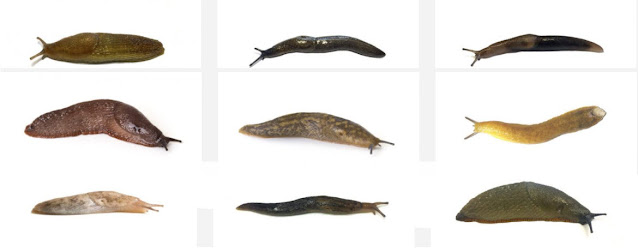
There are 29 species of slug in Britain, about half of which can be found in the garden. Most slugs
eat decaying vegetation, but readily switch to young or delicate plants, feeding on the leaves,
stems, roots and tubers. They evolved from snails and in the course of doing so lost all, or most of
their shell. All slugs are hermaphrodites, in that they have both male and female sex organs.
Mating and cross-fertilisation is the norm, but every individual produces the spherical translucent
eggs. These are laid in batches in damp places in the soil or under stones. A small replica of the
adult emerges from the egg, and takes between 2 months and a year to mature. The activity of
slugs and snails is highest in spring and autumn. Slugs need to keep moist at all times otherwise
they will dehydrate and die: thus they are nocturnal and more active when it is wet
There is a trick practiced by allotment holders for making your own slug-killing nematode potion, using only a bucket, some weeds, rain water and the slugs from your own garden. This is based on the fact that in an average garden some slugs will already carry bacterial diseases or be infected with nematodes, but their low density means that they won’t devastate the rest of the population. By catching and confining some, if the disease or nematodes are present, you can concentrate these micro-predators and harness their natural slug killing power.
1. Collect as many slugs as you can find in a jar that has a few small air holes punctured in the lid with a hammer and a nail. Add a few weed leaves for them to eat. The best time to hunt for slugs is after dark. In the gloom the slugs will eat on top of the leaves as opposed to hiding in a cool dark and damp place by day.
2. Once you have caught around 10 to 20 slugs – the more you have, the better it works – decant them into a bucket with an inch or so of water in the bottom for humidity and add a few more handfuls of leaves to make an edible floating island for your catch. With the slugs inside, place a firm cover such as a concrete slab over the top to seal them in. The bucket is the perfect environment for the bacteria and nematodes to breed. Nematodes spread in water so check regularly, giving the slugs a stir with a stick. The idea isn’t to drown them, but to keep them moist so the nematodes can hunt them out. Although cheating a little, you can use a bought pack of nematodes to help your brew along. Empty about a teaspoon of powder into the bucket to help it along.
3. After around 2 weeks a high level of nematodes will have built up inside the bucket and the slugs will have died from infection. Now you can dilute the brew; fill the bucket to the top from the tap on your rain water butt and decant into a watering can fitted with a rose. Prevent the weed and slug mixture from falling into the can with a filter (chicken wire) if possible.
4. Water the brew around vulnerable plants, where the raised nematode population will seek out resident ground-dwelling slugs and see them off. This brew should give up to six weeks protection. Save the contents of the sieve (if you have the stomach) to start your next brew.
(Based on an article by Toby Buckland that appeared in the Telegraph on 3rd August 2011) which you can no longer access on the web without subscribing to the paper.
Following the article by Toby Buckland this was published Home made slug killing soup? A case of well intentioned pseudoscience? | nurturing nature (nurturing-nature.co.uk)

